How a Scalable Demand Gen Engine Is Built: The Five Building Blocks
TL;DR: Most B2B companies have enough campaigns, enough content and enough ideas. What is missing is the connection between them. A demand generation engine delivers qualified leads predictably, month after month, because five building blocks work together: positioning, CRM, behaviour-based automation, handover to sales and ongoing optimisation.
The difference between a campaign and an engine
Most of the B2B companies I talk to do not have a problem with demand generation in the narrow sense. Their problem is that none of it is connected.
A campaign brings attention for a few weeks. A demand generation engine delivers qualified leads predictably, month after month, without anyone having to start from scratch each time. After several years of B2B marketing consulting I keep seeing the same five building blocks that make the difference.
1. Positioning that makes a real decision
Before any campaign starts, it has to be clear who it is for, and who it is explicitly not for. Most positioning is worded so broadly that it fits almost any company. That feels safe but is the opposite: without a clear ideal customer profile, neither marketing nor sales knows when a lead really fits.
2. A CRM that is the foundation, not just the filing cabinet
This is where an engine most often tips over in practice, and it is exactly the interface I have specialised in. Many companies have a CRM, but it is a contact database, not a system. Without a clean data structure, defined lifecycle stages and clear handover rules between marketing and sales, every campaign remains a flash in the pan. The engine only runs once the foundation is right.
3. Marketing automation that reacts to behaviour
Scalable demand generation does not mean sending more emails. It means building nurturing tracks that react to what contacts actually do, instead of running through rigid schedules. A contact who visits a pricing page three times needs a different approach than one who read a blog article once.
4. A handover to sales that really works
The most common friction between marketing and sales does not come from bad leads, but from different definitions of what a good lead is. A scalable engine needs jointly defined criteria for MQL and SQL. Otherwise lead generation in B2B stays an endless point of dispute instead of a shared process.
5. Continuous optimisation instead of a one-off setup
This building block is underestimated most often. An engine that is set up once and then left alone loses its effect within a few months. Campaigns, content and scoring models need ongoing care, not a one-off measure.
How to tell which building block is missing
You do not have to check everything. A few questions are enough to find the gap:
- Can marketing and sales each describe who your ideal customer is, independently of each other? If not, building block 1 is missing.
- Do you know which source your best customers came from, and is it recorded in the CRM? If not, building block 2 is missing.
- Does every contact get the same approach, whatever they did? Then building block 3 is missing.
- Is there an argument about which leads are any good? Then building block 4 is missing.
- When did someone last rework a scoring model or a nurturing track? If you cannot remember, building block 5 is missing.
If you want to record the answers in a structured way, the RevOps Readiness Check helps. It shows in twelve statements where your processes and data stand.
Why most demand gen initiatives do not scale
When a marketing strategy does not work, the fault almost never lies in a single channel. It lies in the five building blocks being thought of separately: one agency for campaigns, a freelancer for content, an IT provider for the CRM, and nobody who owns the big picture.
How I put this into practice
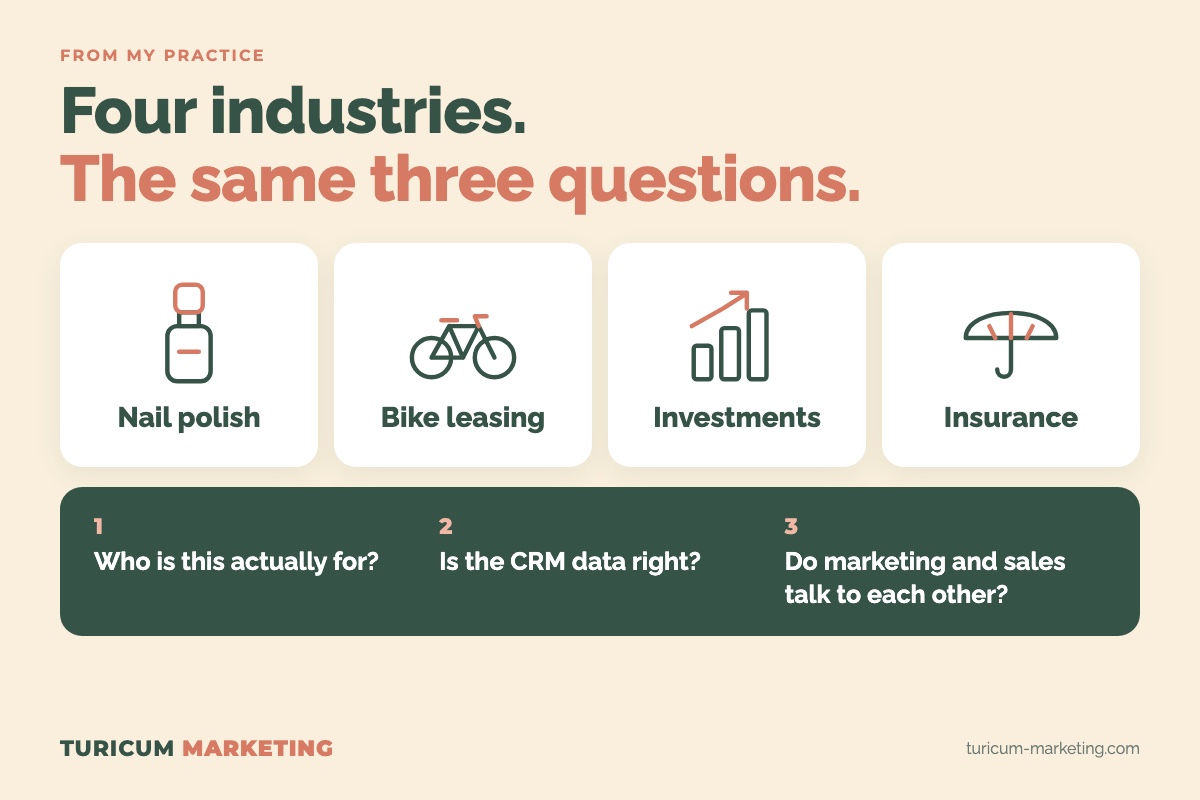
That is why my team and I at TURICUM Marketing do not work channel by channel, but on the system itself. At Generali we built a data-based scoring model and a modular nurturing flow for cold contacts from brand activation campaigns, with a clearly measurable increase in real, qualified leads. At LEVA the focus was building the complete demand generation engine from the ground up: CRM, campaign planning and positioning thought through together, not one after the other. You can find more under References.
Where to start
In the end, a scalable demand generation engine is not a marketing project. It is a business system that holds marketing, sales and data together. Anyone who only works on the campaign surface will never get there.
The most sensible first step is a review that shows which building block is missing and turns it into a sequence. That is the core of our Marketing Audit with roadmap. How we approach demand generation overall is described on the page Demand Generation for B2B.